Segmenting, Targeting and Positioning:
Reaching the Right User
Background: Segment-Target-Position (“STP”) is a framework that helps marketers understand their audience, identify which group of users will be receptive to their message and lastly, craft the right message to make that user group take a desired action (download, purchase, visit a website or make a phone call for example).
Why is it important? As markets mature and consumers have more options and choices it becomes ever more important to give them a clear and differentiated reason to buy your product. When competition intensifies and consumers become overwhelmed they will look for the easiest way to make a decision which is typically to stick with what they know works, what their friends recommend or what provides a perceived benefit that other products lack. A product which targets the right audience with the right message has a much higher chance of getting the desired action than one that doesn’t.
In addition, the other thing that happens as markets mature is that not all of your customers will respond in the same way to the same message. For example, say you’re providing some sort of SAS. Initially, your clients respond well to the basic product message and offering. “Try our SAS because it solves this problem and is easy to implement.” However, as the industry matures some clients may become more concerned about security, customer service, cutting edge innovation. In this case, not only do you have to have the right message but you also have to customize your message / marketing differently depending on which audience you’re targeting.
When should I do this?
Ideally before you build and launch your product. A large part of your business plan should be predicated on this and most likely this kind of conversation will come up with investors.
After launch if the market changes, becomes more competitive or you’re thinking of how to develop your product roadmap going forward
Who owns this? Typically your head of marketing / communications owns this but for it to work STP has to have buy in across the entire senior team, PR team and should be sanity-checked with existing / potential customers as well.
How does it work? STP is a step-by-step process whose ultimate goal is to provide a convincing call to action to specific user demographics or segments.
Segmentation: What am I trying to achieve here?
To understand what currently matters to your users and what might matter to them
To understand how your competitors are positioned vs. how you are
To understand each segment of your market and how your competitors and you are talking to each segment
To understand from the above if there is a segment whose needs are not met that you can target that will be receptive to your message
To understand whether your offering can really differentiate compared to what’s out there from competitors
Say, for example, you’re developing racing car games. The market might currently be segmented on a) type of gameplay and b) variety of cars. In this case you’re segmentation grid might end up looking something like this:
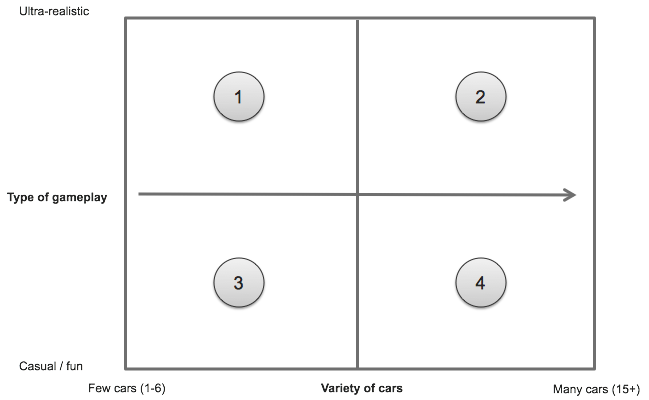
So the first thing to do here is to place each of your competitors in a quadrant. Then place yourself in a quadrant. Questions this exercise should answer once completed:
Am I in the right category?
How well am I addressing my category?
How attractive (or not) is each category (size, revenue potential)?
Does my messaging / advertising reflect which category I think I’m in?
How crowded is each category?
How well do my competitors compete in their categories?
Do these categories really reflect what consumers care about?
Is there an underserved category that competitors have missed?
Target: Once you’ve segmented your audience you then have to choose which segment to go after. This becomes your target audience. Your end goal is to try to come up with a positioning statement / marketing message that will get the attention of this particular segment with the aim of serving them better than your competitors. When thinking of which audience you should target ask yourself the following questions (and be honest!):
How well do I compete in my category?
How crowded is my category?
How crowded are the other categories?
How well do my competitors compete in their categories?
Do these categories really reflect what consumers care about?
Do I have the core competence (in terms of resources and organization) to defend myself in my quadrant)?
Can I own this category (and if so for how long)?
Can my target audience change? Yes, your target audience can change over time as the market changes or it can change if you decide to consciously change your product and go after a different audience. Keep in mind,however, that actually getting any desired target audience to understand your message and how your product differentiates takes time. When you change target you’re essentially often starting over and most likely will lose some if not all of the positioning that you have built over time with the previous audience.
Can I / should target multiple audiences? Yes, but it really depends on your product and service. Again, as markets mature you will likely have to target different audiences with slightly different messages in order to stay relevant and avoid other, smaller competitors from coming in and taking certain targets from you.
Take for example our racing game above. Initially, maybe you broadly targeted Male / Female gamers 18-24 and you focused your messaging on variety of cars and realism. While that approach may work initially, as the market matures there may be certain demographics that look for other things that might be more relevant to them then simply the variety of cars or the realism that you have. For example, maybe the male 15-18 demographic is actually more interesting in crashing cars and blowing things up. In this case adjusting the features of your game to include crashable models and maybe even adding an element of “car combat” might make sense and allow you to target those gamers with a more relevant message. Alternatively, you might add multi-player racing to your game and target some users with the message that your game is “the most social racing game out there” and challenge users to test their skill against their friends.
Over time you may find that you actually are targeting multiple target audiences with slightly different messages with different value propositions.
3. Positioning: Once you’ve identified who your target is than the final step is to come up with the most compelling positioning / value statement for that audience.
The positioning statement is, in effect, the 1-2 reasons why the consumer should consider your product and try / buy it. The key here is to sum up for the consumer in as short and concise a way as possible why they should consider your product over someone else’s. More importantly, once you decide on a positioning statement you should always attempt to use it across as much of your marketing materials as possible and as consistently as possible. Consider the following positioning statements:
Music, Movies, Books, Apps and more. On Android and the Web
Brand: Google play
Product: App / content storefront
Logic: The android team wanted to clearly communicate the users that you could find multiple types of content on Google play and that this content was both accessible and consumable not just on Android devices but on any device with web access
Make advertising rewarding
Brand: Ifeelgoods
Product: Rewards platform that provides digital content to brands / agencies as a reward for consumers clicking on / engaging with ads
Logic: CTR’s on ads are low and consumers find ads uninteresting / boring. IFG solution is to provide context-driven digital rewards for any consumer who engages with a brand’s ad thereby making every ad more fun and rewarding
What makes for a strong positioning statement?
1. It’s clear, short and concise
2. It’s easy to understand
3. It’s easy to remember
4. It differentiates the product
5. It’s ownable; not everyone else can claim it
6. It’s directly linked to the company’s core competency / strengths
Bonus
It not only does the above but also re-positions competitive products in a negative or inferior light. Consider the following statement:
Volvo: The safest car in America
Not only does this statement clearly position Volvo as a safe car brand but it also potentially might cast doubt on the safety of other cars. By doing this Volvo not only creates a clear space that they can own but can also potentially reposition some of its competitors if it so chooses.
OK, what do I do once I have a positioning statement?
Communicate it as often as possible and as consistently as possible in all your marketing communications:
Email / CRM
on your website
Advertising materials - video, digital / mobile banners, print, outdoor, TV…
Any press materials - press kits, press releases, company communications
Have your executives trained on it and always communicate it in public forums
Make sure it’s applied using the same language as consistently as possible
Walk your PR agency / top execs through it and make sure everyone understands the why of it and knows how to talk to it
Share it openly with your employees, partners and board and explain the logic behind it
-Mad Mork

 Posts
Posts


