Showing posts with label Entrepreneurship. Show all posts

Tuesday, 9 February 2016

Why the Job Hunt Process is so Broken

As someone so immersed in tech, I have to admit I'm stumped on this one.  How is it humanly possible that given all the cool tech we build - drones, VR / AR, Mobile apps, Bio Tech etc. that our recruiting process is stuck in the stone ages?
When you work in startups you go in and out of jobs.  That's just the name of the game.  So on a personal level I've found myself in between jobs more than once. However, I'm continuously amazed by how arcane our recruitment system is.
Why is our recruiting process so broken?
1.  Recruiters generally have to play it safe. Even when I was at Google, there was a generally accepted norm:  look inside Google first. The reason was simple: existing Googlers have the skills, know the culture, products, pace and processes. They'll get up to speed faster, require less on-boarding and pose less risk.  In startups it's very much the same thing once the company starts to really grow and get traction.  Whereas a bad hire at Google won't kill the company, if you hire the wrong head of sales in your startup and your revenues go "poof" then you could be out of business.  Most firms always look for people with experience (at least on paper).  To make things more complicated, external recruiters generally have to reimburse the company or find a replacement candidate if the candidate they put forward doesn't work out within a set time period.  So both internally and externally most organizations are incentivized to find the "safest" candidate which is not always the "best" candidate.  
2.  There's no money in helping consumers find jobs (yet).  This sounds harsh but the money in the recruitment business is on the enterprise side.  Linkedin, Executive Search Firms, Glassdoor, Monster and Co all make money from who? From companies looking to hire talent.  To date nobody has really done a good enough job to encourage job seekers to spend money on recruitment services. By default if you're looking for a job then you're probably cashflow negative (ie losing money each month) so forking over more money on job search tools / services will be a tough sell for job seekers (unless of course these can guarantee you find a job).  The good news is some people are trying to create marketplaces for both job seekers and companies that serve both.  Hired, which just announced it raised money today, is attempting to do just that.  Though the site only accepts resumes from candidates that they curate (ie - select) they will pay candidates a cash bonus if they find a job through the site.  They also focus more on "active" instead of passive candidates making it easier for firms to find people who are actually looking for a job instead of people who aren't looking to move.  
3.  Experience Trumps "passion".  Steve Jobs once said: "Do what you love and you'll never work another day in your life."  The literature is there to back it up too.  Survey after survey shows that passionate employees are significantly more productive than others with the same skills who aren't passionate.  In addition, passionate employees are often more motivated, have more energy, motivate those around them and lead healthier lives.  They even have a greater chance of having stronger personal relationships as an article in the Huffington Post pointed out last year.  When you're happy at work and feeling that what you do has purpose,  you're more likely to go home happy and treat those you love more kindly than you would otherwise.  But the reality is that measuring passion and assigning a value to it is really hard to do. Companies and recruiters can more easily point to actual skills, work experience and accomplishments to "predict" what a possible candidate will deliver for the company.  Passion and enthusiasm will rarely trump experience though the combination of the two is unbeatable.
 4.  The applicant review process is still manual and impersonal.  Have you ever gotten one of those emails that says: "Thanks for applying for the role of super duper cookie cutter.  Your application is important to us and we'll get back to you as soon as we've reviewed your profile."  6 months later you still have no reply from them.  Sound familiar?   At my last job I must have seen at least 150 different resumes for two roles I was recruiting for.  I answered every single applicant.  Granted I had various templates I'd created based on the applicant type, skills and length of experience so it's not like I customized every reply.  But the reaction even to these simple emails shocked me:  people wrote back.  I even got replies with people telling me how wonderful I was for my detailed and considerate feedback.  I actually had an email exchange with several candidates about the process in general.    One applicant, who initially sent me a slightly offensive, drunken rant by email, hearing I'd been laid off, actually invited me for dinner and drinks and offered me a consulting assignment.  
In today's day and age of tablets, smartphones and messaging apps its easy to forget people are human and deserve the courtesy of a response.  Software from companies like Lever, Jobvite, Gild and others are helping companies with better Applicant Tracking Systems (ATS) and even Linkedin has their own ATS if you use Recruiter or Recruiter Lite but as employers we still have to do a better job of getting back to people and showing people some respect.  
5.  People sometimes don't know what they want.  It's easy to bitch and moan that "company X never got back to me" or "I just don't have the skills for that job" but in 2 decades of hiring and managing teams I've also come across more than one candidate that simply didn't know what he / she wanted.  I recently interviewed a candidate for a role in the company I worked for who admitted to me: "Honestly, I'm not quite sure at this point of my career what I want.  I'm still trying to figure that out."  Respect has to go both ways.  In the same vein that candidates would like companies to get back to them and update them on the status of their applications they should also come prepared and have a really clear idea of what they are looking for, why their skills matter and what they have to offer the company in question.  Candidates should also spend more time understanding what they are good at, what careers match those strengths and connect the dots.  
OK great, so what can we do as applicants?
 One thing we can all do is get a better understanding of ourselves:  our skills, strengths, weaknesses, motivations and passions.  Knowing ourselves better will allow us to be more focused in our job search.  As a recruiting manager I found that often as many as 50% of the applicants I reviewed either didn't have the right skill set I was looking for or didn't have the right experience.  
Part of the challenge is that people simply aren't aware of the tools that can help them figure out what career paths are available for them.  For example,  one of the things that career coaches or college placement offices may have students do to identify a career path is called a Myers Briggs test or, in some cases a Jung Typology Test.  The test involves answering a series of questions about yourself. Once you've finished answering the questions the test will reveal your personality type formula.  Some sites will also provide you with various career paths that are suitable to your personality.  You can take the test here and it will even show you famous people who match your personality type.  I learned a lot about myself doing this. I don't like large organizations, hate bureaucracy, dislike corporate politics, love to write, enjoy public speaking and need to a lot of autonomy in what I do.   
Aside from the Jung Typology Test, Janet Scareborough Civitelli, a career coach, has a great post you can read on Vocationvillage.com that lists the 10 things you can do to identify the things you're good at.  They include the basics such as getting advice from friends, families and career coaches to skill matching websites and more advanced, in-depth testing that is available in major metropolitan areas if you have the time and money to pursue them.  She also has a number of interesting books worth having a look at.  
I've always been an optimist at heart and I truly believe that each one of us has unique gifts, abilities and talents that we can turn into something that not only helps us pay the rent but also taps into our passions.  We can wait for the system to change or for enterprising entrepreneurs to fix it for us (some will for sure) or we can get a grip on what we do well, find our purpose and set about finding a way to monetize our strengths and passions.  
Part of the answer lies within us.  The question is do we have the courage to pursue it.
The next time you're frustrated with the job hunt process have a look at this rejection of rejection letter and always remember: Keep smilin'
 
Mad Mork

Tuesday, 18 November 2014

Branding 101 for Start-ups

According to recent forecasts, advertising spend will exceed over $50billion in 2015 with the fastest growth coming from mobile.  With that marketers, particularly start-ups, face a daunting challenge:  how to reach users with a compelling message and cut through all the noise.

Today at the Yodlee Interactive bootcamp, I had a chance to share some learnings with aspiring fintech entrepreneurs and take them on a journey about branding.  What is branding?  Why is it important?  what kind of benefits can it bring my company? and more importantly:

How do I get started building a brand?  What's the process and who is involved?  Below is a short preso which attempts to answer some of these questions.  Make sure to download the file and check the slide notes which is where all the detail is.  I hope it helps you!


Download Here

stay Mad, stay foolish,

Mad Mork


Friday, 25 July 2014

Start-up Founders Guide to Public Relations

I've often been amazed by how under-utilized PR is by companies in Silicon Valley.  Often, the vast majority of press you read is limited to simply funding announcements,  product launches and M&A. Since most companies can go quite some time without either of the above happening, many companies pop up onto our radar only to disappear just as quickly as they appeared.

In addition, the few times that companies have the opportunity to get on +Techcrunch, +Venturebeat or the +WallStreetJournal, they don't fully take advantage of the opportunity when they have unclear messaging, rambling product descriptions or miss the opportunity to tell us how their company truly differentiates in the market place.

Finally, when #startup entrepreneurs do get it right they get a brief 24 hour spot in the sunlight which is basically the only public presence that they have until their next press release 6 months later.  What kind of brand presence can you build and sustain over 6 months with two press releases?  Not much.

The reality is that if you're going to do PR seriously you need to need to be religious about it.   Like sales, customer retention, 30 DAU's etc you need to set yourself some goals, measure performance, iterate and improve.  Most importantly, you need to be on it constantly.

When I ran marketing at #GetJar several years ago we put out 2-3 press releases each month.  These were then measured and tracked using #Meltwater and we could go back to our board at the end of the month and tell them the exact dollar value of PR, where we achieved coverage, how much we had vs. competition and how much it cost us to get there.  Not only did we release the obvious like funding announcements, key hires and awards but we also heavily promoted our strategic partnerships with the likes of #ATT, #Yahoo! and others.  We leveraged our data to create blog posts giving people an idea of where the app industry was going (like the App Sizing report with +ChetanSharmaconsulting), which platforms were relevant, which apps most popular and what this meant for the industry as a whole.  We had an opinion and weren't shy about expressing it.  The results at the time spoke for themselves: coverage in every major tech blog on nearly a quarterly basis, winning over 1/2 awards over 2 years, being nominated as "One of The Companies that will change your Life" by #TIME magazine in 2011 and appearances on #CNBC, #BBC, and #Reuters to name a few.

But that's not really the point of this post.  The point is that anybody can significantly boast the visibility and even value of their company by understanding the basics of doing good PR.  Hiring the right agency, the basics of writing a press release, how to leverage social media like #Facebook, #Twitter, #Google+ and #Quibb to make your news go viral and how to evolve the structure of your PR efforts as your company scales.

So enough talk - to make it easier for you I've put together this short Intro to Public Relations deck as part of my work here at #SigniaVC.  It's only about 20 slides and should be short and simple reading.  I hope you enjoy it and feel free to post, tweet me #madmork or email me if you have comments or questions.

Good luck!

Madmorks' Intro to Public Relations

Monday, 24 February 2014

An Entrepreneurs Guide on Positioning Your Product for the Right Audience

Segmenting, Targeting and Positioning:
Reaching the Right User


Background:  Segment-Target-Position (“STP”) is a framework that helps marketers understand their audience, identify which group of users will be receptive to their message and lastly, craft the right message to make that user group take a desired action (download, purchase, visit a website or make a phone call for example).

Why is it important?  As markets mature and consumers have more options and choices it becomes ever more important to give them a clear and differentiated reason to buy your product.  When competition intensifies and consumers become overwhelmed they will look for the easiest way to make a decision which is typically to stick with what they know works, what their friends recommend or what provides a perceived benefit that other products lack.  A product which targets the right audience with the right message has a much higher chance of getting the desired action than one that doesn’t.
In addition, the other thing that happens as markets mature is that not all of your customers will respond in the same way to the same message.  For example, say you’re providing some sort of SAS.  Initially, your clients respond well to the basic product message and offering.  “Try our SAS because it solves this problem and is easy to implement.”  However, as the industry matures some clients may become more concerned about security, customer service, cutting edge innovation.  In this case, not only do you have to have the right message but you also have to customize your message / marketing differently depending on which audience you’re targeting.  

When should I do this?  
  • Ideally before you build and launch your product.  A large part of your business plan should be predicated on this and most likely this kind of conversation will come up with investors.  
  • After launch if the market changes, becomes more competitive or you’re thinking of how to develop your product roadmap going forward

Who owns this?  Typically your head of marketing / communications owns this but for it to work STP has to have buy in across the entire senior team, PR team and should be sanity-checked with existing / potential customers as well.

How does it work?  STP is a step-by-step process whose ultimate goal is to provide a convincing call to action to specific user demographics or segments.

  1. Segmentation:  What am I trying to achieve here?
    1. To understand what currently matters to your users and what might matter to them
    2. To understand how your competitors are positioned vs. how you are
    3. To understand each segment of your market and how your competitors and you are talking to each segment
    4. To understand from the above if there is a segment whose needs are not met that you can target that will be receptive to your message
    5. To understand whether your offering can really differentiate compared to what’s out there from competitors

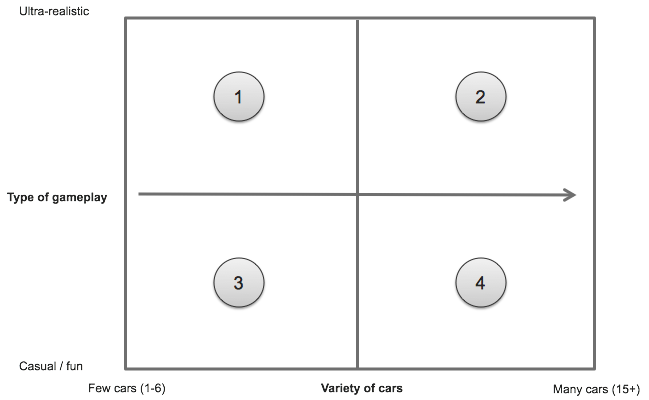
Say, for example, you’re developing racing car games. The market might currently be segmented on a) type of gameplay and b) variety of cars.  In this case you’re segmentation grid might end up looking something like this:


So the first thing to do here is to place each of your competitors in a quadrant.  Then place yourself in a quadrant.  Questions this exercise should answer once completed:

  1. Am I in the right category?
  2. How well am I addressing my category?
  3. How attractive (or not) is each category (size, revenue potential)?
  4. Does my messaging / advertising reflect which category I think I’m in?
  5. How crowded is each category?
  6. How well do my competitors compete in their categories?
  7. Do these categories really reflect what consumers care about?
  8. Is there an underserved category that competitors have missed?

  1. Target:  Once you’ve segmented your audience you then have to choose which segment to go after.  This becomes your target audience.  Your end goal is to try to come up with a positioning statement / marketing message that will get the attention of this particular segment with the aim of serving them better than your competitors.  When thinking of which audience you should target ask yourself the following questions (and be honest!):

    1. How well do I compete in my category?
    2. How crowded is my category?
    3. How crowded are the other categories?
    4. How well do my competitors compete in their categories?
    5. Do these categories really reflect what consumers care about?
    6. Do I have the core competence (in terms of resources and organization) to defend myself in my quadrant)?
    7. Can I own this category (and if so for how long)?

Can my target audience change? Yes, your target audience can change over time as the market changes or it can change if you decide to consciously change your product and go after a different audience.  Keep in mind,however, that actually getting any desired target audience to understand your message and how your product differentiates takes time.  When you change target you’re essentially often starting over and most likely will lose some if not all of the positioning that you have built over time with the previous audience.

Can I / should target multiple audiences?  Yes, but it really depends on your product and service.  Again, as markets mature you will likely have to target different audiences with slightly different messages in order to stay relevant and avoid other, smaller competitors from coming in and taking certain targets from you.

Take for example our racing game above.  Initially, maybe you broadly targeted Male / Female gamers 18-24 and you focused your messaging on variety of cars and realism.  While that approach may work initially, as the market matures there may be certain demographics that look for other things that might be more relevant to them then simply the variety of cars or the realism that you have.  For example, maybe the male 15-18 demographic is actually more interesting in crashing cars and blowing things up.  In this case adjusting the features of your game to include crashable models and maybe even adding an element of “car combat” might make sense and allow you to target those gamers with a more relevant message.  Alternatively, you might add multi-player racing to your game and target some users with the message that your game is “the most social racing game out there” and challenge users to test their skill against their friends.

Over time you may find that you actually are targeting multiple target audiences with slightly different messages with different value propositions.

3.  Positioning: Once you’ve identified who your target is than the final step is to come up with the most compelling positioning / value statement for that audience.    

The positioning statement is, in effect, the 1-2 reasons why the consumer should consider your product and try / buy it.  The key here is to sum up for the consumer in as short and concise a way as possible why they should consider your product over someone else’s.  More importantly, once you decide on a positioning statement you should always attempt to use it across as much of your marketing materials as possible and as consistently as possible.  Consider the following positioning statements:

Music, Movies, Books, Apps and more.  On Android and the Web
Brand: Google play
Product: App / content storefront
Logic:  The android team wanted to clearly communicate the users that you could find multiple types of content on Google play and that this content was both accessible and consumable not just on Android devices but on any device with web access

Make advertising rewarding
Brand: Ifeelgoods
Product: Rewards platform that provides digital content to brands / agencies as a reward for consumers clicking on / engaging with ads
Logic:  CTR’s on ads are low and consumers find ads uninteresting / boring. IFG solution is to provide context-driven digital rewards for any consumer who engages with a brand’s ad thereby making every ad more fun and rewarding

What makes for a strong positioning statement?

1.  It’s clear, short and concise
2.  It’s easy to understand
3.  It’s easy to remember
4.  It differentiates the product
5.  It’s ownable; not everyone else can claim it
6.  It’s directly linked to the company’s core competency / strengths

Bonus

It not only does the above but also re-positions competitive products in a negative or inferior light.  Consider the following statement:

Volvo: The safest car in America

Not only does this statement clearly position Volvo as a safe car brand but it also potentially might cast doubt on the safety of other cars.  By doing this Volvo not only creates a clear space that they can own but can also potentially reposition some of its competitors if it so chooses.

OK, what do I do once I have a positioning statement?

Communicate it as often as possible and as consistently as possible in all your marketing communications:

  • Email / CRM
  • on your website
  • Advertising materials - video, digital / mobile banners, print, outdoor, TV…
  • Any press materials - press kits, press releases, company communications
  • Have your executives trained on it and always communicate it in public forums
  • Make sure it’s applied using the same language as consistently as possible
  • Walk your PR agency / top execs through it and make sure everyone understands the why of it and knows how to talk to it
  • Share it openly with your employees, partners and board and explain the logic behind it

-Mad Mork